Meal planning
Meal Planning to Reduce Household Food Waste
A household workflow that turns EPA, FDA and CDC guidance into practical planning, shopping and leftover habits that cut food waste.
Quick answer: Check what needs using before you choose meals, plan fewer meals than your household can realistically cook, write the grocery list from those meals, buy amounts you'll actually use, and give leftovers a dated place in the plan. RecipeRun connects your saved recipes, the weekly plan and one combined grocery list, but you still need to look in your own kitchen and decide whether food is safe to eat.
Meal planning won't eliminate every kind of food waste. Plans change, food spoils sooner than expected and some parts are never edible. What it does well is make the food you buy line up more closely with the meals you actually intend to cook.
Why household food waste matters
The EPA's Sustainable Management of Food Basics says that in 2019 alone, about 66 million tons of wasted food were generated in the food retail, food service and residential sectors, and most of it (about 60%) was sent to landfills. EPA's Feed It Onward figures, from its 2025 report "Estimating the Cost of Food Waste to American Consumers", put the cost at home at $728 per person a year and $2,913 for a family of four, or about 11% of household food spending.
Those national figures cover more than forgotten vegetables at the back of the fridge, and an average doesn't tell you what any one family wastes. Start with your own patterns rather than applying a national number to your home.
The EPA's guide to preventing wasted food at home puts planning first. It recommends looking in your refrigerator, freezer and pantry before you shop, planning the week's meals and buying only what those meals need. It also suggests writing quantities on the list, such as "salad greens - enough for two lunches", so you don't overbuy.
A seven-step low-waste meal-planning loop
1. Observe one ordinary week
For seven days, note any edible food you throw out and why. You don't need a kitchen scale to see patterns. Useful categories include:
- Bought without a specific use.
- Planned meal never got cooked.
- Package was bigger than the amount used.
- Leftover was forgotten.
- Food was stored incorrectly or kept too long.
- Nobody wanted the meal.
- Product didn't meet expectations.
- Food was thrown out for a safety reason.
Don't eat anything questionable just to make the record look better. The point is to find the planning decision you can change next time.
2. Check what needs using first
Before picking recipes, look through the fridge, freezer and pantry. Check labels, condition and how each item has been stored. Make a short "use first" list of food that's still good and should shape the next few meals.
A meal-planning app can't tell whether something stayed at a safe temperature or is still good to eat. Follow the storage instructions on the package and official food-safety guidance.
3. Plan for reality, including empty spaces
Count the evenings when people will actually eat at home. Add known leftovers, meals out, late nights and one flexible meal if your week often changes.
Planning five dinners you'll really cook often wastes less than buying for seven fixed dinners and abandoning two. A freezer or pantry meal can fill a gap without adding more perishable ingredients.
4. Choose meals that share ingredients deliberately
Use the "use first" food in the early meals, and give the rest of each likely purchase a second job. For example:
- Spinach split between a curry and a frittata.
- Roasted vegetables served as a side, then folded into a wrap.
- A bunch of cilantro used in two recipes instead of one garnish.
- A slightly bigger batch of a suitable dinner, with one portion set aside for a named lunch.
Overlapping ingredients should still add up to meals people want to eat. Don't pick several unpopular dishes just to use up one product; uneaten cooked food is still waste.
5. Build and subtract one grocery list
Pull the ingredients from the chosen recipes, combine genuine duplicates, then cross off what you already have. Add exact quantities where they matter.
Before you buy a bigger package or a sale pack, decide:
- How much the planned meals use.
- How you'll store the rest.
- Which named meal will use it.
- Whether that second use is realistic before the food goes bad.
NIST's guide to unit pricing explains that a unit price shows how much you pay per unit, such as per ounce, so you can compare value across package sizes. Not every state requires stores to post unit prices, so where your store doesn't show one, divide the price by the size yourself. A lower unit price can point to better value, but the whole package still has to fit what your household will eat and store. As the EPA notes, buying in large quantities, such as buy-one-get-one-free deals, only saves money if you use all the food before it spoils.
6. Make leftovers visible and safe
Label stored leftovers with what they are and when you made them, then put them on the meal plan instead of relying on memory. Keep a simple freezer list if frozen portions are hard to see.
The CDC's guidance on preventing food poisoning says to refrigerate cooked leftovers within 2 hours, or within 1 hour if the food has been exposed to temperatures above 90°F, like a hot car or a picnic. It recommends packing warm food into several clean, shallow containers before refrigerating, and keeping the refrigerator at 40°F or below and the freezer at 0°F or below. It lists 165°F as the safe internal temperature for leftovers and casseroles, and says to use a food thermometer when reheating. The CDC's food safety tips for dining out add a time limit: eat leftovers within 3 to 4 days and throw them out after that.
Follow the label and the advice of your local food-safety authority. How the food was stored and what kind of food it is both matter; a meal-plan entry is never evidence that a leftover is safe.
7. Review the result before planning again
At the end of the week, look at what was left over and why. Then change one decision in the next plan:
- Buy a smaller package.
- Plan fewer meals.
- Make a smaller batch.
- Schedule leftovers earlier in the week.
- Stop buying a product your household keeps leaving.
- Keep one flexible meal instead of another fresh-ingredient recipe.
Small, repeated corrections give you a plan that fits your household. A generic "zero-waste" menu can't know these habits.
An example use-first plan
Say the kitchen check turns up half a head of cabbage, several carrots, an open tub of yogurt and a frozen cooked meal. The goal isn't to force them all into one dish; it's to give each usable item a clear destination.
Swipe horizontally to compare
| Food found | Decision before shopping | Possible plan entry | Important check |
|---|---|---|---|
| Half a head of cabbage | Use early in the week | Stir-fry or slaw from a chosen recipe | Condition and how it was stored |
| Several carrots | Split across two meals | Sheet-pan dinner and soup | Quantity actually needed |
| Open yogurt | Use only if it's still good | Breakfast, sauce or snack | Label directions, date and storage |
| Frozen cooked meal | Schedule before another batch cook | Busy-night dinner | Label, freeze date and safe reheating |
| Open package of tortillas | Count how many are left | Wrap dinner or lunch | Condition and realistic servings |
Once these entries are on the plan, choose the remaining recipes and build the grocery list around them. Don't buy replacements out of habit.
Understand "Best if Used By" and other date labels
US date labels aren't standardized. The FDA's Tips to Reduce Food Waste says that, except for infant formula, manufacturers aren't required by federal law or regulation to put quality-based date labels on packaged food. FDA supports Best if Used By as the standard phrase for the date when a product will be at its best flavor and quality, and estimates that confusion over date labeling accounts for 20 percent of consumer food waste.
For food past its "Best if used by" date, FDA says to check for signs of spoilage and to consider avoiding it if it has changed noticeably in color, consistency or texture. A date never cancels out unsafe storage, though: food left out longer than the 2-hour limit isn't made safe by a later date on the package. Always follow the product's storage instructions.
UK labels work differently. GOV.UK guidance says a use-by date tells you when food is no longer safe to eat, while food is usually safe after its best before date but may not be the same quality.
How RecipeRun can help
RecipeRun handles the link between your recipes, your plan and your list:
- Save recipes from websites, photos, screenshots and handwritten cards.
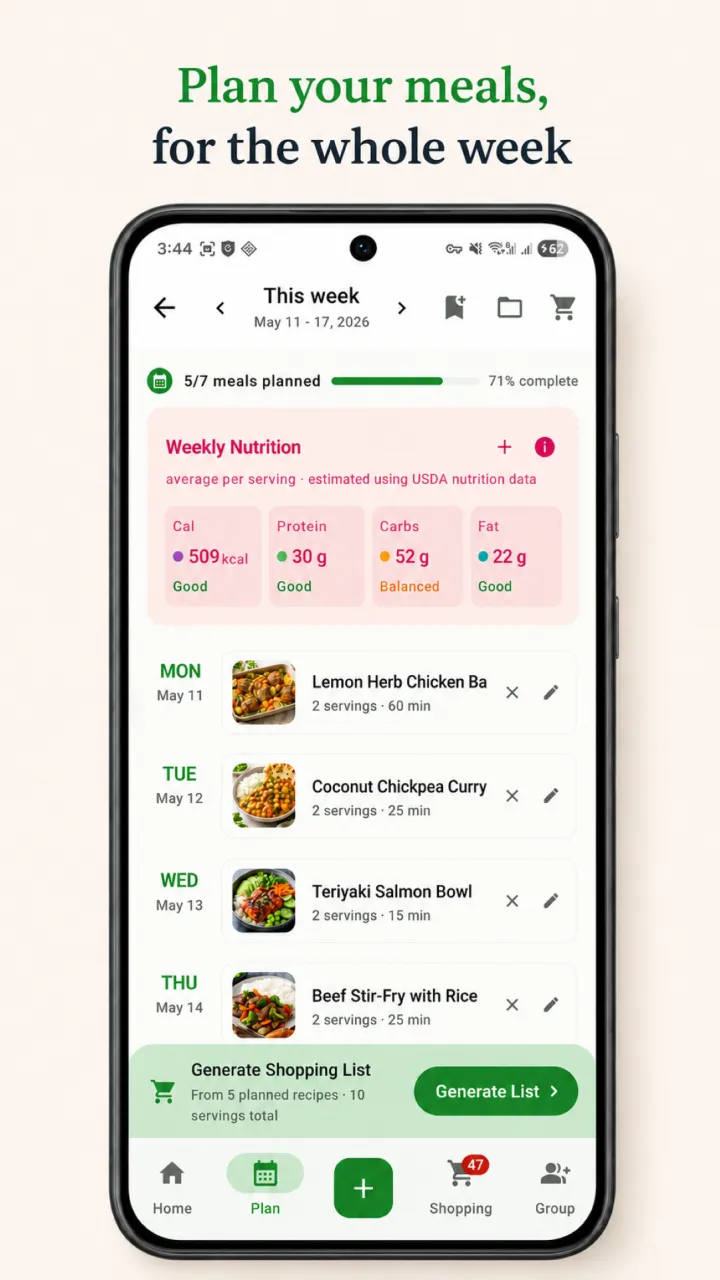
- Put the recipes you choose on a weekly meal plan.
- Generate one combined grocery list without duplicates.
- Keep the list up to date when the meal plan changes.
- Share recipes, plans and lists through Family Groups.
A useful low-waste routine in RecipeRun looks like this:
- Check the kitchen and pick out the food to use first.
- Choose or adapt saved recipes around that food.
- Add only the meals you're likely to cook.
- Generate the list and remove everything you already have.
- Review quantities and package sizes before you buy.
- Put a planned leftover meal on the week instead of assuming you'll remember it.
- Update the plan when things change so the ingredients you bought still have a destination.
RecipeRun doesn't physically inventory your kitchen, judge whether food is safe or guarantee that an ingredient extraction is correct. Those checks stay with you.
Learn how to combine several recipes into one reviewed grocery list, follow the broader weekly meal-planning system, or explore RecipeRun's recipe manager features.
A simple household food-waste review
Keep a short table for two or three weeks. Record enough detail to reveal a decision you can change, without turning it into a chore.
Swipe horizontally to compare
| Food thrown out | Approximate amount | Why it was thrown out | Next planning change |
|---|---|---|---|
| Example: salad greens | Example: part of one bag | Bought for one meal; the rest had no plan | Buy a smaller amount or add a named second use |
| Example: cooked dinner | Example: one portion | Leftover wasn't visible in the fridge | Label it and schedule it for lunch the next day |
| Example: bread | Example: several slices | Household ate less than expected | Freeze some of the loaf earlier |
These are example entries, not measured results. Use your own observations and follow safe-storage guidance.
Frequently asked questions
Does meal planning reduce food waste?
It helps you buy closer to the meals you intend to cook, plan a use for opened packages and keep leftovers in view. It can't prevent every cause of waste, and the result depends on following the plan and updating it when the week changes.
Should I plan every meal for the week?
Not necessarily. Plan only the meals you can predict with some confidence. Leaving room for leftovers, a freezer meal or a change of plans can stop you from buying perishables you won't use.
Is food safe after its "Best if Used By" date?
FDA describes "Best if Used By" as the date when a product will be at its best flavor and quality. It says to check food past that date for signs of spoilage and to consider avoiding anything that has changed noticeably in color, consistency or texture. Infant formula is treated differently under federal date-labeling rules. In the UK, treat a use-by date as a safety deadline.
How long can I keep leftovers?
It depends on the food and how it was stored. CDC guidance says to refrigerate leftovers within 2 hours, keep the fridge at 40°F or below, and eat leftovers within 3 to 4 days. Check the full official guidance and your local food-safety advice.
Does RecipeRun track what is in my fridge?
RecipeRun builds grocery lists from the recipes and meals you choose; it doesn't physically check your fridge, freezer or pantry. Do that check yourself and edit the list before you shop.
Can comparing grocery prices prevent waste?
Comparing prices and preventing waste answer different questions. A low unit price doesn't help if the extra amount goes unused. Compare value only after you've decided how much the plan really needs.
Plan from what you already have
Check the kitchen, pick three realistic meals and generate the list from those recipes. RecipeRun is free to download on Google Play and the App Store.
Sources and disclosure
- Sustainable Management of Food Basics, U.S. Environmental Protection Agency, accessed October 9, 2026.
- Feed It Onward, U.S. Environmental Protection Agency, accessed October 9, 2026.
- Preventing Wasted Food at Home, U.S. Environmental Protection Agency, accessed October 9, 2026.
- Uniform Unit Pricing: Tools for Consumers to Fight Shrinkflation, National Institute of Standards and Technology, accessed October 9, 2026.
- Preventing Food Poisoning, Centers for Disease Control and Prevention, accessed October 9, 2026.
- Food Safety Tips for Dining Out, Centers for Disease Control and Prevention, accessed October 9, 2026.
- Tips to Reduce Food Waste, U.S. Food and Drug Administration, accessed October 9, 2026.
- Best before and use-by dates, GOV.UK, accessed October 9, 2026.
This guide is published by the team that makes RecipeRun. It provides general planning information, not medical, dietary or food-safety advice for an individual's circumstances.